
Why Standup Bots Make Standups Better
Updated: May 27

Let's be honest. The daily standup had a great pitch. Fifteen minutes. Keep it short. Stay aligned. Ship faster.
And then reality showed up.
Somewhere between the person who treats every standup as a TED Talk and the one who clearly forgot it was happening, the fifteen minutes became thirty, the blockers went unresolved, and half the team stopped paying attention by minute four.
It's not that standups are a bad idea. It's that the live meeting format was never really built for the way modern teams work. Distributed time zones, back-to-back calendars, and the simple fact that most people do their best thinking when they're not being watched by twelve colleagues on a video call.
A standup bot fixes this. Not by replacing the standup, but by making it work the way it was always supposed to.
What Is a Standup Bot?
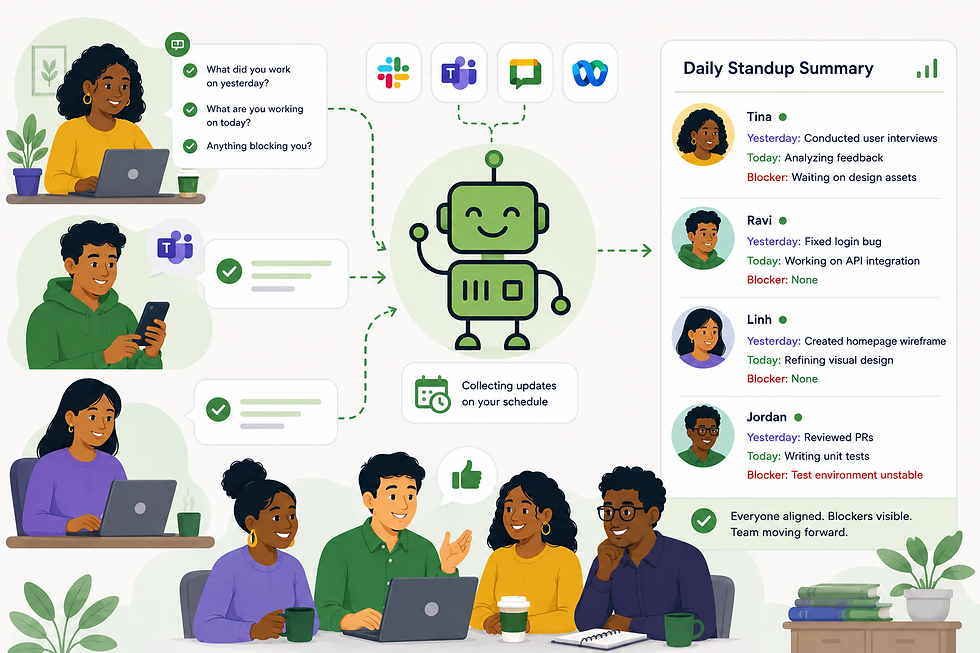
A standup bot is a tool that lives inside your team's communication platform, whether that's Slack, Microsoft Teams, Google Chat, or Cisco Webex. Its job is simple: prompt each team member to answer a few questions every day, collect the responses, and compile them into a summary the whole team can read.
No scheduling. No waiting for everyone to show up. No one accidentally joining from their car.
The three core questions most bots ask are:
What did you accomplish yesterday?
What are you working on today?
Are there any blockers?
That's it. Team members respond when it works for them. The bot handles the rest.
Key features to look for in a standup bot include:
Scheduled automated reminders
Customizable prompt questions
Summary reports with status and blockers
Interactive features like comments and reactions
What Standup Bots Actually Do for Agile Teams
A lot of people assume standup bots are just a fancier way to ask the same three questions. They're not.
When implemented well, a standup bot changes how information moves through a team entirely.
They automate the repetitive stuff. Daily check-ins are essential but nobody needs to manually coordinate them. Bots handle the prompting, the collecting, and the summarizing so managers can stop chasing updates and start acting on them.
They make async work actually work. Global teams and flexible schedules don't fit neatly into a 9am meeting slot. Bots remove the time zone problem entirely by letting people respond when they're at their best.
They standardize the format. When everyone answers the same questions the same way, the quality of information goes up and the ambiguity goes way down.
They surface patterns over time. The same blocker showing up three weeks in a row is a system problem, not a people problem. Bots log everything so leaders can actually see those trends.
They increase participation. Some people dominate live standups. Others go quiet. Written async updates give everyone an equal voice, which tends to produce more honest and more useful information.
Standup Bot vs. Traditional Standup: An Honest Comparison
Here's how the two formats stack up across the things that actually matter:
Aspect | Traditional Standup Meeting | Standup Bot |
Timing | Fixed time; everyone must attend simultaneously | Asynchronous; members respond at their convenience |
Format | Verbal, live updates | Written responses via chat |
Duration | 15 to 30 minutes; often extends if blockers arise | 5 minutes or less, flexible |
Participation | Risk of some being passive or dominated by others | Equal voice through individual responses |
Follow-up | Often manual or forgotten | Automated summaries and action items |
Inclusivity | Difficult with distributed teams and time zones | Easy for global teams |
Data Tracking | Minimal unless manually documented | Automatically logged and accessible |
How to Run Effective Standups With a Bot
Switching to a standup bot doesn't require a big rollout.
Most teams are up and running in under an hour. Here's what the setup looks like in practice:
Choose your bot and platform. Pick a tool that integrates with whatever your team already uses. Standup Alice supports Slack, Microsoft Teams, Google Chat, and Cisco Webex, so there's no need to add another app to anyone's desktop.
Customize your questions. The classic three questions are a solid starting point, but don't be afraid to tailor them. "What's your priority today?" often gets more useful answers than "What are you working on?"
Set clear expectations. Make sure the team knows the bot isn't surveillance. It's a tool to reduce friction, surface blockers early, and keep everyone aligned without adding another meeting to the calendar.
Review the summaries and act on them. A standup summary nobody reads is just a very organized to-do list nobody reads. Use the reports to spot blockers, recognize wins, and track velocity over time.
Refine as you go. Ask for feedback after the first few weeks. Adjust question formats, timing, or frequency based on what your team actually finds useful.
A Sample Standup Prompt Template
Not sure where to start with your questions? Here's a template that works well for most teams:
Question | Purpose | Example Answer |
What did you accomplish yesterday? | Understand progress and celebrate wins | Finished the homepage design |
What will you work on today? | Set clear expectations for the day | Begin backend API integration |
Are there any blockers? | Identify issues early for swift resolution | Waiting on client feedback |
Do you need help from anyone? | Promote collaboration and support | Need QA to review new features |
Any process improvements to flag? | Encourage continuous improvement | Suggest adding code linting rules |
Common Standup Bot Objections (And Why They Don't Hold Up)
Every team has at least one person who will push back on the standup bot idea. Here's what they'll say and what the data actually shows:
Objection | Reality |
"Bots feel impersonal. Meetings build rapport." | Bots save time on status updates, not relationship building. Use the time you get back for one-on-ones and team retrospectives instead. |
"People won't respond honestly." | Async written formats actually tend to produce more thoughtful and honest responses than live meetings where social pressure is high. |
"I won't be able to read body language or tone." | True. Written updates have limits. Video calls and one-on-ones still have a place. The bot just handles the daily logistics so those conversations can focus on what matters. |
"It's just another tool to manage." | A standup bot actually reduces the number of things to manage. No scheduling, no note-taking, no chasing people for updates. |
Advanced Ways to Get More Out of Your Standup Bot
Once the basics are running smoothly, there's a lot of room to optimize. Teams that get the most out of standup bots tend to do a few things differently:
Use Summaries to find patterns. If the same blocker keeps showing up in reports, it's not a coincidence. Standup Alice delivers a fresh summary report to your team channel every day, so patterns like that are impossible to miss before they derail a sprint.
Our blog on how to write better standup updates is a good companion read if your team's responses tend to be vague or inconsistent. Better inputs lead to better summaries.
Recognize consistent contributors. Teams that celebrate quality updates tend to get more of them. A quick shoutout in the channel for someone who flagged a blocker early goes further than you'd think.
Make it safe to flag blockers. The best standup cultures are the ones where nobody hesitates to say they're stuck. If people feel like admitting a blocker means getting grilled in the next meeting, they'll stop flagging them. Async updates lower that pressure significantly.
Reserve live meetings for real conversations. Use the bot for daily updates and save synchronous time for the discussions that actually benefit from being in the room together.
What Teams Are Actually Seeing
The results teams report after switching to async standup bots tend to follow a pretty consistent pattern:
Distributed teams across multiple time zones report saving up to two hours per week by eliminating synchronous standups
Software teams have reduced blockers by up to 40 percent through earlier detection in daily bot reports
Managers report higher engagement and significantly better documentation, especially during remote onboarding
If you're weighing the full case for automation, our blog on the top benefits of automating daily standup meetings breaks down the productivity gains in more detail.
The Bottom Line
Standup bots don't make standups less human. They make them more efficient.
The daily standup is still one of the best habits an Agile team can have. Short, consistent, focused check-ins create alignment and surface problems before they become expensive.
The bot just removes the parts that were never really necessary:
the fixed time slot, the calendar invite, the waiting for everyone to join, and the meeting that somehow became thirty minutes again.
What you're left with is the part that actually works. Clear updates. Visible blockers. A team that knows what everyone is working on without having to ask.
That's not a worse standup. That's a better one.
Ready to see what your standups look like without the meeting?
Standup Alice prompts your team daily, collects their updates, and delivers a clean summary straight to your team channel. Works in Slack, Microsoft Teams, Google Chat, and Cisco Webex.


Comments