
What Is a Scrum Standup Bot and Does Your Team Actually Need One?
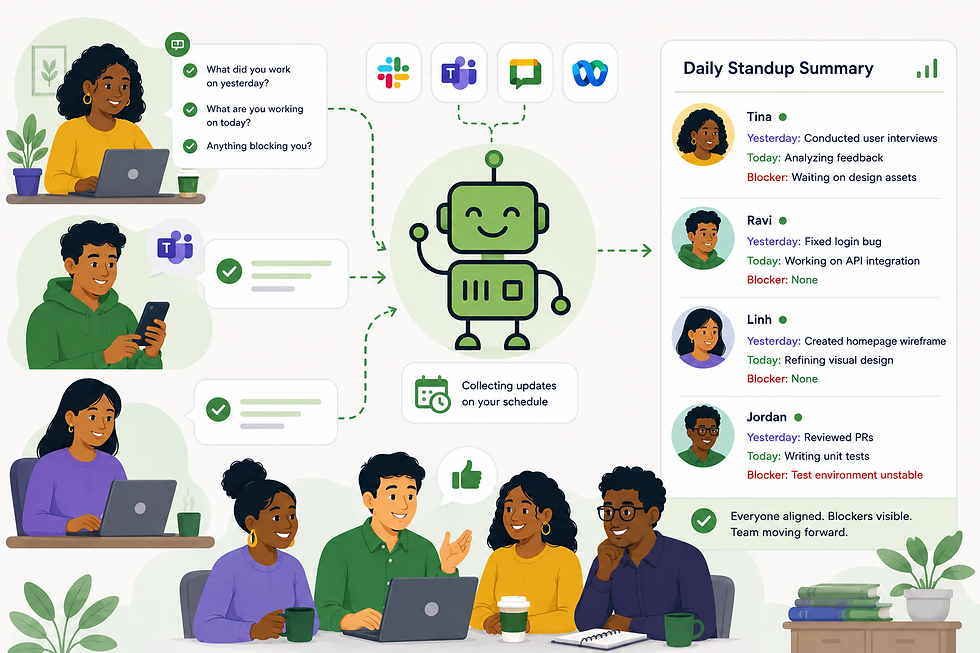
If you've ever sat through a daily scrum meeting where half the team was clearly multitasking, the other half was waiting to talk, and the whole thing ran 25 minutes instead of 15, you already understand the problem a standup bot solves.
You just might not know that's what it's called.
This post explains what a scrum standup bot is, how it fits into a Scrum workflow, and whether your team would actually benefit from using one. No jargon required.
Let's Start With the Basics: What Is Scrum?
Scrum is a way of organizing work. It's especially popular with software teams, but plenty of marketing, design, and operations teams use it too.
The basic idea is simple: instead of planning a huge project months in advance and hoping everything goes according to plan, Scrum teams work in short cycles called sprints, usually one to two weeks long. At the end of each sprint, the team reviews what got done, adjusts the plan, and starts again.
It's built for teams that need to move fast and adapt when things change, which is most teams.
What Is a Daily Scrum Meeting?
One of the core habits in Scrum is the daily scrum, sometimes called a standup. It's a short check-in where team members answer three questions:
What did I work on yesterday?
What am I working on today?
Is anything blocking me?
That's it. The whole point is to keep everyone aligned and to surface problems before they slow the sprint down. In theory, it takes 15 minutes. In practice, it often takes longer, runs off-topic, and leaves remote teammates waiting around for information they could have read in two minutes.
That's where a standup bot like Standup Alice comes in.
So What Is a Scrum Standup Bot?
A scrum standup bot is a tool that automates the daily check-in. Instead of gathering everyone in a video call at a fixed time, the bot sends each team member a message with the three questions. Team members answer on their own schedule. The bot collects all the responses and compiles them into one clean summary that the whole team can read.
Think of it like this: imagine if instead of everyone standing in a circle and taking turns speaking, each person quietly wrote their update on a sticky note, and then someone pinned all the sticky notes on a board for everyone to read at once. Same information. No waiting. No one dominating the conversation.
That's what a standup bot does, just in Slack, Microsoft Teams, Google Chat, or Cisco Webex instead of a physical room.
How Does It Actually Work?
Here's what the process looks like from start to finish:
Step | What happens | Who does it |
1. Setup | The team installs the bot and sets a schedule for when prompts go out | Admin or team lead |
2. Daily prompt | The bot messages each team member with the standup questions | The bot |
3. Team responds | Each person answers the questions whenever it works for them | Team members |
4. Summary delivered | The bot compiles all responses into one clean report in the team channel | The bot |
5. Team stays aligned | Everyone reads the summary, spots blockers, and knows what's happening | Whole team |
The whole thing runs automatically every day. No scheduling. No waiting for people to join. No meeting.
What Makes It Different From Just Posting in a Slack Channel?
Good question. You could technically ask your team to post updates in a Slack channel every morning. A lot of teams try this. Here's why it usually falls apart:
Some people forget because there's no prompt
Updates get buried under other messages
There's no consistent format so updates are hard to compare
Nobody compiles a summary so managers still have to piece it together manually
Participation drops off after the first week
A standup bot solves all of that. It prompts everyone automatically, keeps the format consistent, and delivers a compiled summary without anyone having to do it manually.
For a deeper look at why the format matters as much as the habit, our blog on why standup bots make standups better breaks down exactly what changes when you go from live meetings to structured async updates.
Is a Scrum Standup Bot Only for Software Teams?
Not at all. Scrum started in software development, but the standup habit works for any team that needs to stay coordinated on ongoing work.
Marketing teams use standup bots to track campaign progress. Design teams use them to flag when they're waiting on feedback. Operations teams use them to surface problems before they become expensive. Customer support teams use them to stay aligned on priorities.
If your team has more than two people working on overlapping projects, a standup bot is useful. The questions scale to any kind of work.
Our blog on how to customize standup questions for marketing, design, and non-dev teams has practical examples if your team isn't in engineering.
What Should You Look for in a Scrum Standup Bot?
Not all standup bots are built the same. Here's what actually matters when you're choosing one:
Feature | Why it matters |
Works in your existing tools | If the bot lives in a separate app, people stop using it fast. Look for one that works in Slack, Teams, or Google Chat |
Customizable questions | The standard three questions are a great start but your team might need something different |
Automated summary reports | The bot should compile updates into a readable summary so nobody has to do it manually |
Flexible scheduling | Remote teams need bots that respect different time zones |
Blocker visibility | Blockers should stand out in the summary so they get addressed quickly |
Easy for anyone to use | If setup takes more than a few minutes, your team will skip it |
Standup Alice checks all of these. It works inside Slack, Microsoft Teams, Google Chat, and Cisco Webex. Questions are fully customizable. Summaries are delivered to the team channel automatically every day. And the whole thing takes about five minutes to set up.
Does a Standup Bot Replace the Daily Scrum Meeting?
For most teams, yes. The daily scrum meeting exists to share the information that a standup bot collects automatically. When everyone can read a clean summary in two minutes instead of sitting through a 15-minute call, most teams find they don't need the live meeting anymore.
That said, bots don't replace every kind of conversation. Sprint planning, retrospectives, and complex problem-solving still benefit from real-time discussion. The bot handles the daily status update. Everything else stays human.
Our blog on which agile meetings can be automated has a full breakdown of which scrum ceremonies benefit from automation and which ones still need a real conversation.
Final Thoughts
A scrum standup bot is not a complicated tool. It does one thing: it makes sure your team's daily check-in actually happens, produces useful information, and doesn't waste anyone's time.
For teams that are already running daily scrums, it makes the habit more consistent and less disruptive. For teams that have tried and failed to make standups stick, it removes the friction that usually causes them to fall apart.
Either way, the result is the same: a team that knows what's happening every day, without another meeting on the calendar.
Ready to see what your standups look like without the meeting?
Standup Alice prompts your team daily, collects their updates, and delivers a clean summary straight to your team channel. Works in Slack & Microsoft Teams.


Comments