
What Is a Standup Summary and Why It Matters

Daily standups are meant to create clarity, alignment, and momentum.But in many teams, the real value of a standup isn’t the meeting itself — it’s what happens after the updates are shared.
That’s where a standup summary comes in.
In 2026, as remote and async teams continue to grow, standup summaries have become one of the most important tools for keeping teams aligned without increasing meetings. A clear standup summary helps teams stay informed, leaders make decisions faster, and work move forward without confusion.
This guide explains what a standup summary is, why it matters, and how modern teams use it effectively.
What Is a Standup Summary?
A standup summary is a concise recap of team updates collected during a daily standup.
It typically includes:
What each team member worked on
What they’re working on next
Any blockers or risks
Key signals that need attention
Instead of relying on memory or scattered messages, the summary captures the team’s status in one clear place.
In async-first teams, the standup summary often becomes more valuable than the standup itself.
Why Is a Standup Summary Important?
Standup summaries matter because they turn individual updates into shared understanding.
Here’s why teams increasingly rely on them:
1. They Create Alignment Without Meetings
Not everyone can attend every standup — especially in distributed teams. A summary ensures everyone stays aligned, regardless of time zone or schedule.
2. They Reduce Repeated Questions
Instead of asking:
“What’s the status of X?” Teams can simply refer to the latest summary.
3. They Surface Blockers Early
When blockers are clearly highlighted in a summary, leaders can act faster — before small issues become delays.
4. They Support Async Workflows
Modern teams don’t want constant pings. A summary allows people to consume updates when it fits their workflow.
What Should Be Discussed in a Standup (and Reflected in the Summary)?
A strong standup summary mirrors a strong standup structure.
Most effective summaries include:
Update Area | Why It Matters |
What was completed | Shows progress and momentum |
What’s next | Creates visibility into priorities |
Blockers | Enables quick support |
Dependencies | Prevents misalignment |
Risks or delays | Helps teams adapt early |
The goal isn’t detail — it’s clarity.
What Is the Main Purpose of a Standup Meeting?
The main purpose of a standup is alignment, not reporting.
Standups exist to help teams:
Stay aware of progress
Identify obstacles early
Coordinate next steps
Maintain momentum
A standup summary ensures that purpose continues after the standup ends.
In fact, many modern teams now design their standups around the summary — not the other way around.
Live Standups vs Standup Summaries (2026 Perspective)
Approach | Strength | Limitation |
Live standup meeting | Real-time discussion | Time-zone friction, meeting fatigue |
Chat-based updates | Fast to send | Easy to miss, unstructured |
Standup summary | Clear, shared visibility | Needs consistency |
Automated standup summary (StandupAlice) | Consistent, async, actionable | Requires initial setup |
This is why more teams are shifting toward automated summaries instead of manual notes.
How Standup Summaries Work in Async Teams
In async environments, the workflow looks like this:
Team members submit updates on their own schedule
Updates follow a consistent structure
A summary is generated automatically
The summary is shared with the team (Slack, email, dashboard)
This removes:
Manual note-taking
Missed updates
Follow-up messages
And replaces them with one clear daily signal.
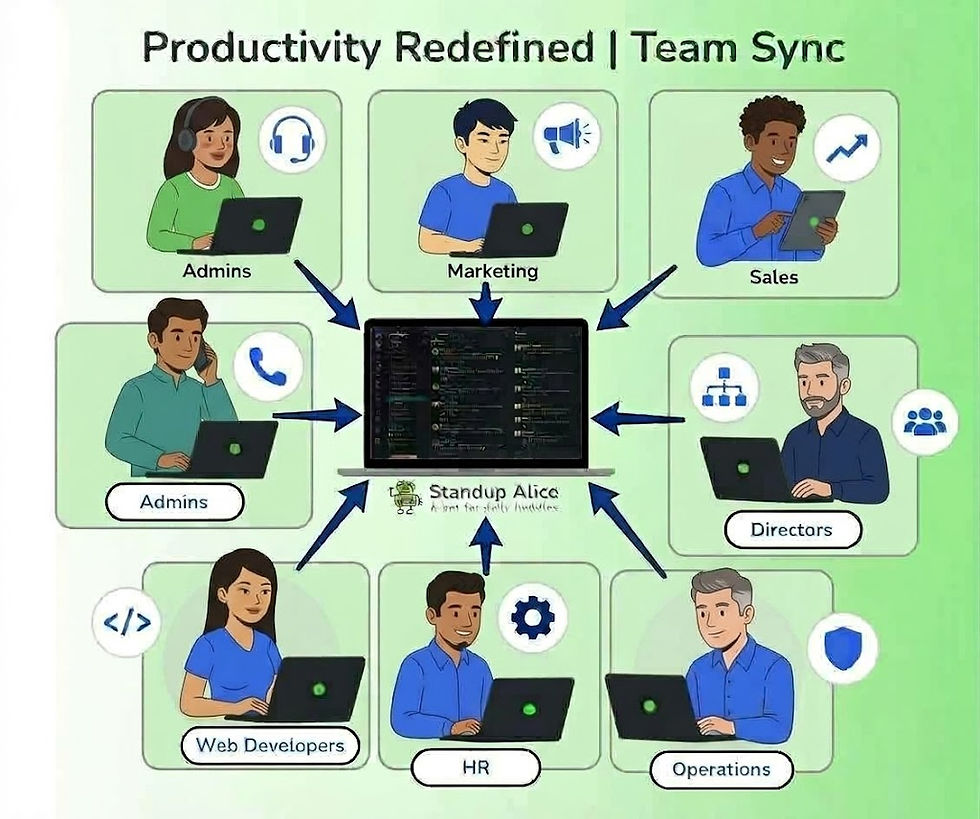
Where Standup Alice Fits In
Instead of asking teams to attend meetings or write long updates, Standup Alice:
Collects structured async updates
Automatically generates clear daily summaries
Highlights blockers and trends
Delivers summaries directly into Slack or email
For managers and stakeholders, this means:
Instant visibility
No chasing updates
Better decisions with less noise
Common Mistakes Teams Make With Standup Summaries
Even teams that create summaries sometimes struggle. Common issues include:
Too much detail
Inconsistent formats
Manual copying and pasting
Summaries that arrive too late
The best summaries are:
Short
Structured
Consistent
Easy to scan
Automation plays a big role in making that happen.
If you’re exploring better ways to run standups and async updates, these resources build on how summaries improve alignment and decision-making:
Final Thoughts
Standups aren’t about meetings.They’re about shared understanding.
In 2026, the teams that move fastest aren’t the ones meeting more — they’re the ones creating clear, reliable standup summaries that everyone can trust.
Whether your team meets live or works fully async, a strong standup summary ensures alignment continues long after updates are shared.
And for teams ready to remove friction entirely, tools like Standup Alice turn daily updates into a system that works quietly — and effectively — in the background.


Comments