
The Future of Remote Work: Asynchronous Communication Tools

Remote work isn’t slowing down — it’s evolving.
Teams today aren’t just working from different locations… they’re working from different cities, time zones, and sometimes completely different work rhythms. And while real-time meetings still have their place, companies worldwide are shifting toward something far more scalable:
Asynchronous communication.
In 2025, async workflows have become the backbone of high-performing remote teams. Why? Because async allows work to move forward without requiring everyone to be online at the same time — making collaboration smoother, faster, and far less disruptive.
This shift is powering a new kind of remote work culture: one that is focused on clarity, autonomy, and deep work.
And at the center of this evolution?
Smart asynchronous tools like Standup Alice.
Why Asynchronous Communication Is the Future of Remote Work
As remote work matures, companies are prioritizing:
Time flexibility
A global talent pool
Reduced meeting overload
Clear, documented updates
Work progress that continues around the clock
Instead of forcing teams into real-time conversations, async tools allow people to contribute when they’re most focused — early morning, late night, or mid-afternoon.
This shift has created a work environment where:
1. Productivity Increases Naturally
Async minimizes interruptions, giving people longer blocks of deep focus time.
2. Meetings Drop Significantly
Teams replace unnecessary check-ins with structured async updates.
3. Communication Becomes Clearer
Everything is written, shared, and searchable — no more “I missed the meeting.”
4. Global Collaboration Becomes Seamless
A developer in Pakistan can hand off work to a designer in Canada who continues overnight.
What Is Asynchronous Remote Work?
Asynchronous remote work means people don’t need to communicate or respond immediately. Instead, they share updates, decisions, and progress on their own schedule, using tools that capture work in a structured way.
This helps eliminate the pressure of being “always online” — a common issue in remote teams.
What Will the Future of Remote Work Look Like?
Based on 2025 trends, the future remote workplace will revolve around:
✔ Fewer Live Meetings, More Async Updates
Companies will only hold meetings for alignment or strategic decisions.
✔ AI-Assisted Communication
Tools like Standup Alice will summarize updates, extract blockers, and highlight risks automatically.
✔ Flexible Work Schedules
Teams will prioritize outcome-based work, not “hours online.”
✔ Borderless Hiring
Teams will hire based on talent, not location.
✔ Documented Collaboration
Written decision logs and progress updates will replace chaotic message threads.
Async communication is no longer just a productivity hack — it’s becoming the operating system of remote-first companies.
Which Tools Are Commonly Used for Asynchronous Communication?
Remote teams rely on a mix of platforms, but the ecosystem is shifting toward tools built specifically for async collaboration.
Comparison Table: Top Asynchronous Communication Tools for Remote Teams (2025)
Tool | Best For | Key Strength | Limitations |
Standup Alice | Daily async updates & visibility | AI summaries, alignment insights, blocker tracking | - |
Slack / Teams | Quick messaging | Wide adoption | Can become noisy; not structured |
ClickUp / Asana | Task management | Project visibility | Requires manual updates |
Loom / ScreenRec | Video async updates | Human context | Not ideal for daily alignment |
Notion / Confluence | Documentation | Collaborative writing | No automated updates |
Why Standup Alice stands out:
It’s purpose-built for async standups and alignment — not just messaging or documentation. Teams get structured responses, context-aware summaries, and automated insights they can act on immediately.
Why Asynchronous Tools Like Standup Alice Are Transforming Remote Teams
Teams using async updates consistently report:
1. Better Visibility Across Departments
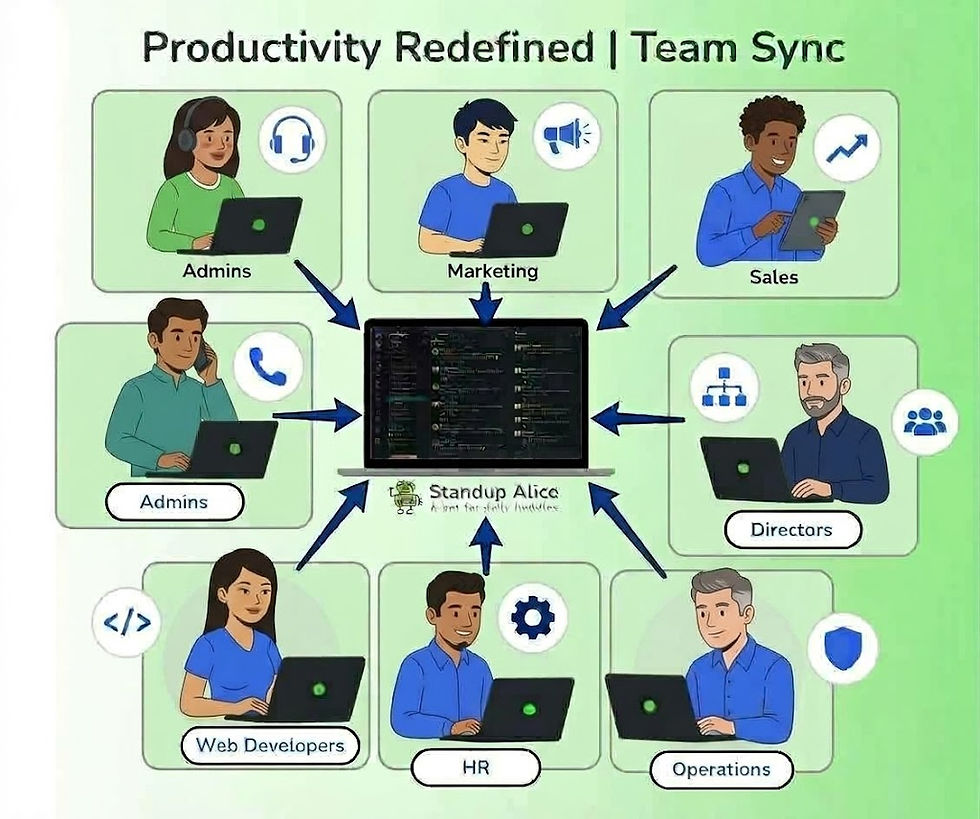
Standup Alice shares daily summaries with managers, helping them spot delays early.
2. Stronger Accountability
Each team member provides written updates, reducing confusion and “he said / she said” moments.
3. More Confident Sprint Planning
With clean async updates every day, planning becomes a data-driven process.
4. Faster Decision-Making
Async tools eliminate the need to wait for the next meeting.
5. Lower Stress and Burnout
People no longer feel pressured to respond within seconds.
Async is not just a communication method — it’s improving how teams think, plan, and deliver work.
How Standup Alice Fits Into the Future of Async Communication
Standup Alice is designed for the next phase of remote work:
✔ Automated daily async standups
✔ AI-powered blocker detection
✔ Cross-team visibility dashboards
✔ Contextual insights for sprint reviews and planning
✔ Integrations with Slack, Teams, and Google Chat
✔ Data that drives decision-making
This makes it one of the most future-proof tools remote teams can add to their stack.
If you're exploring async workflows, you may also find value in our related guides:
Final Thoughts
As the workplace becomes more global and asynchronous, the teams that thrive won’t be the ones doing the most meetings — they’ll be the ones using async tools intelligently.
Standup Alice sits at the center of this transition, giving teams clarity, structure, and alignment without forcing everyone into the same timezone.
Remote work isn't the future.
Async is.
And tools like Standup Alice make that future easier, faster, and far more productive.


Comments