
Does Async Standup Kill Team Morale? Here's What the Critics Get Wrong.
There's a growing argument floating around Agile circles that goes something like this: async standups quietly erode team morale, isolate people from real-time context, and trade genuine collaboration for the illusion of productivity.
It's a fair concern to raise. It's also missing the actual cause.
Teams don't lose morale because updates happen asynchronously. They lose morale when async becomes a synonym for disconnected. Those are two very different things, and the difference comes down entirely to how the system is built.
The Real Argument Against Async Standups
The criticism usually goes like this: when standups move async, conversations happen in isolation. There's no shared context, no chance to catch a tone shift, no organic moment where someone says "actually, that connects to what I'm working on." Real-time exchange gets traded for a checklist.
That's a legitimate failure mode. It's just not a failure of async communication. It's a failure of async communication done without structure.
What Actually Damages Team Morale
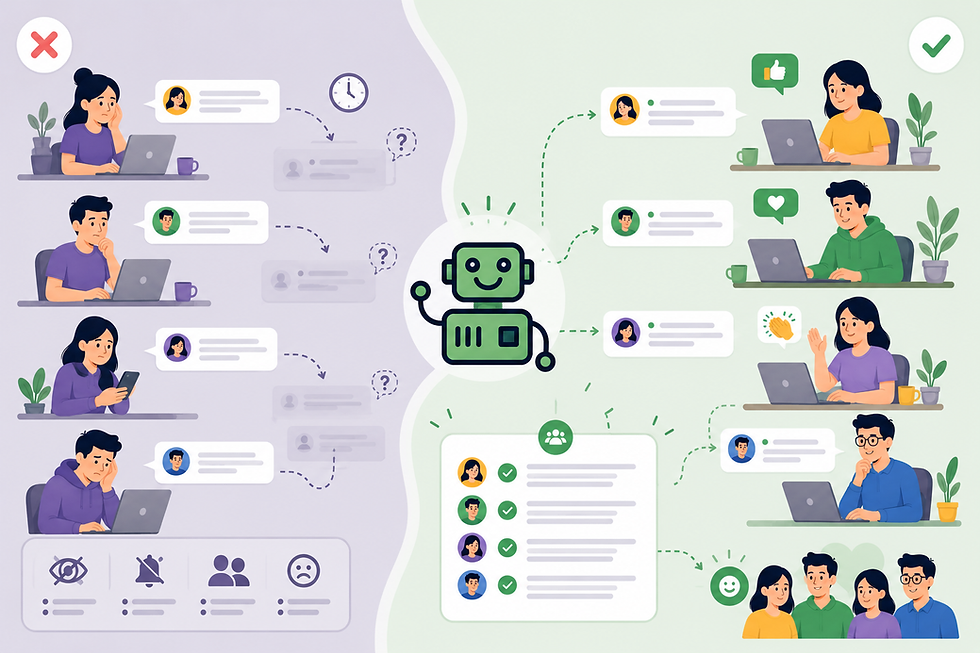
Team morale doesn't erode because people answer questions on their own schedule. It erodes when:
What actually hurts morale:
Updates disappear into a void nobody reads
Blockers go unanswered for days
No one acknowledges wins or contributions
People feel like they're talking to a form, not a team
What async standups actually fix:
Equal voice for every team member, not just the loudest
A visible, shared record everyone can reference
Blockers surfaced the moment they're flagged
Recognition built into the format, not left to chance
Notice that the things that genuinely hurt morale have almost nothing to do with timing. A live meeting where nobody listens is just as isolating as a written update nobody reads. The format isn't the problem. Silence is.
Async Standups Were Never Supposed to Replace Connection
This is where a lot of the "async kills morale" argument loses its footing. Async standups were never meant to replace human connection. They were meant to replace the most repetitive, least valuable part of the day: a status report disguised as a meeting.
Teams that do this well don't disappear into silos. They use the time they get back from skipping a live status meeting to actually talk to each other, in retrospectives, one-on-ones, and the kind of spontaneous conversation that a calendar invite never produces anyway.
Our blog on remote teams don't fail because people are remote goes deeper on why visibility, not face time, is what actually keeps distributed teams connected.
The Difference Is What Happens to the Update
Here's the actual variable that determines whether async standups build morale or quietly drain it: what happens to the update after it's submitted.
If a team member writes "blocked on API specs" and that sits unread in a busy Slack channel, the bot didn't kill morale. The lack of follow-up did. If that same update flows into a clean, visible summary report that a manager actually reads and responds to, the exact same written update becomes a moment of support instead of a moment of isolation.
Standup Alice is built around that distinction specifically. Every update gets compiled into an organized summary report and delivered to the team channel, so nothing submitted by a team member goes unseen. Blockers get visibility immediately instead of waiting for someone to scroll back through a thread.
That's the part competitors who only talk about "automating standups" tend to skip. Automation without visibility is just a faster way to ignore people.
Recognition Has to Be Built Into the System
One of the most common reasons async communication starts to feel cold is that wins go unacknowledged. In a live meeting, a quick "nice work on that" costs nothing and happens naturally. In an async format, that same recognition has to be intentional, because nobody is going to stumble into it.
Teams that protect morale in an async setup build small habits around this: reacting to updates, calling out a win in the weekly recap, flagging consistency. None of that requires a meeting. It just requires someone to actually look at what was submitted.
If recognition and consistency are something your team struggles with, our newer Streaks feature in Standup Alice was built to make consistency visible and worth celebrating without adding any extra work.
Async Done Right Builds More Trust, Not Less
The strongest argument for structured async standups isn't speed. It's trust. When updates are visible, documented, and consistently followed up on, people stop wondering whether their work is being noticed. They stop needing to over-explain themselves in a live meeting just to feel seen.
That's a very different outcome than the isolation critics describe, and the gap between the two comes down entirely to whether the system around the standup was built with intention or just bolted on as a shortcut.
Final Thoughts
Async standups don't kill team morale. Standups that go unread, unanswered, and unacknowledged do, whether they happen live or async.
The teams getting real value out of async communication aren't the ones who removed connection from their workflow. They're the ones who removed the parts that never created connection in the first place, and replaced them with a system where every update is actually seen.
That's not a smaller version of collaboration. It's a more intentional one.
Ready to see what your standups look like without the meeting?
Standup Alice prompts your team daily, collects their updates, and delivers a clean summary straight to your team channel. Works in Slack & Microsoft Teams.



Comments